7 Structural Shifts Redefining the Modern Automotive Showroom Experience
The modern automotive showroom is evolving rapidly. Discover the seven structural shifts reshaping dealership environments—from EV education and digital retail alignment to connected infrastructure and operational visibility.
By Scala Team
mars 4, 2026
Share
Key takeaways
·
Most buyers arrive after extensive online research, making the dealership visit a confirmation step rather than the start of the journey.
·
EV technology, charging infrastructure, and software features require structured in-store education to build buyer confidence.
·
Service lanes, operational analytics, and centralized content governance are becoming essential components of the modern dealership environment.
·
The most effective dealerships are shifting from installing displays for visual impact to building scalable digital infrastructure that supports operations and consistency across locations.
The automotive showroom is no longer just a display space.
It is a validation environment.
An education center.
An operational hub.
As buyer behavior evolves and dealership models modernize, physical retail environments must keep pace. Customers now move fluidly between digital research and in-person visits. Dealership groups are consolidating operations. EV complexity is rising, retail footprints are changing, and experience needs to meet expectations.
These shifts are driving structural changes in automotive retail that go far beyond adding more screens or refreshing décor.
Here are seven structural shifts redefining the modern automotive showroom and what they mean for dealership leaders. The modern automotive showroom experience now sits at the intersection of digital retail, physical validation, and operational strategy. As automotive retail digital transformation accelerates, dealerships must rethink how technology, content, and infrastructure align across online and in-store environments.
1. Bridging Online Research and In-Store Validation
Today’s buyer rarely walks into a dealership uninformed. Pricing comparisons, trim levels, financing options, and research are often completed online before the first showroom visit.
The role of the physical dealership has shifted: From discovery to confirmation.
The modern showroom must reinforce what the buyer has learned and seen along the way — consistent online/offline messaging, validated advertised pricing, and product comparisons. If a customer configured a vehicle online, that configuration should be easy to revisit and discuss in-store. If incentives were displayed digitally, they should be consistently presented on-site.
Breaks in messaging such as outdated promotions, inconsistent pricing, missing model information all erode trust quickly. As automotive retail digital transformation accelerates, alignment between digital and physical channels is becoming foundational rather than optional.
What dealership leaders should consider:
What is the messaging strategy that flows from online to in-person digital displays?
Are in-store communications synchronized with digital retail platforms, and how?
Can associates easily access and display the same information customers saw online?
Is pricing and incentive messaging updated in real time?
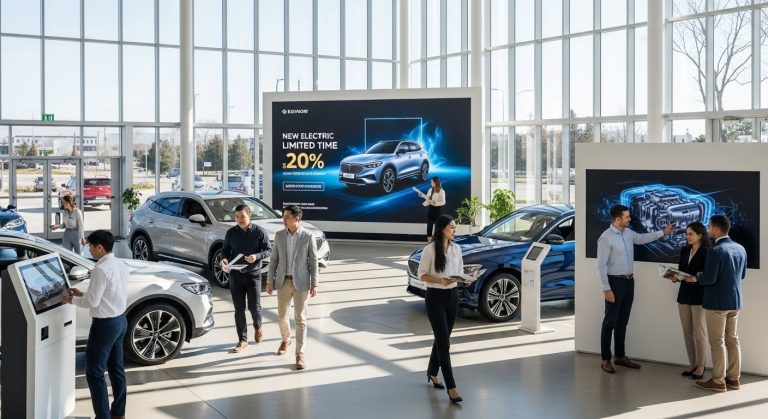
From street-facing displays and billboards, to kiosks and showroom video spectaculars, a clear messaging strategy is key to buyer experience. Bridging digital research with in-store validation is now a baseline expectation within the dealership showroom experience.
2. Education Zones and Ownership Clarity
Electric vehicles and advanced driver-assistance systems have introduced a new level of complexity into the buying process.
Range calculations. Charging infrastructure. Tax incentives. Battery lifecycle. Software updates.
These topics demand more than window stickers.
Forward-thinking dealerships are incorporating structured education zones that complement the research today’s savvy buyers have already done, by helping them understand:
Home and public charging options
Ownership cost comparisons
Available federal and state incentives
Battery warranties and service expectations
Software-driven features and updates
This reflects a structural shift from product display to structured education.
Instead of simply showcasing vehicles, showrooms are becoming guided learning environments. Digital content plays an important role here — enabling consistent explanations of complex topics and helping associates walk customers through unfamiliar territory.
Education is becoming every more central to the physical showroom, particularly in markets with growing EV adoption.
What dealership leaders should consider:
Does the showroom actively reduce uncertainty in options across the board?
Are complex ownership topics explained clearly and consistently?
Is educational content centrally governed and regularly updated?
Clarity accelerates confidence, especially in periods of technological transition.
3. The Service Lane as a Digital Trust Moment
The customer relationship does not end at purchase. In many cases, it is just beginning.
Service lanes are increasingly integrated into broader digital experience strategies. Transparent maintenance education, digital service menus, and warranty explanations are becoming visible components of the retail environment.
Service is becoming a visible part of the dealership’s digital experience ecosystem.
Customers expect the same clarity in the service drive that they experienced in the showroom. Maintenance intervals, EV service differences, software updates, and recall information can all be communicated proactively.
This transparency reinforces trust and reduces friction.
As part of ongoing automotive retail innovation, the service area is evolving from a back-of-house function into a visible trust-building touchpoint.
What dealership leaders should consider:
Is service communication proactive and consistent?
Are service differences such as EV service clearly explained?
Does the service environment reflect the same level of digital alignment as the showroom?
Trust is reinforced long after the sale.
4. Centralized Content Management at Scale
Multi-rooftop dealer groups face a growing operational challenge: content consistency.
Manual updates across locations can lead to:
Inconsistent promotions
Outdated compliance messaging
Brand misalignment
Delayed campaign rollouts
As dealer groups expand, centralized content governance becomes a strategic priority.
This shift moves the conversation from individual screens to enterprise infrastructure.
Modern content management approaches allow corporate teams to control messaging across multiple rooftops while still enabling localized customization where appropriate. Governance frameworks ensure that incentives, pricing language, and compliance requirements are applied consistently.
Infrastructure and governance protect brand trust. Read about how Scala has proven reliability in mission-critical industries such as hospitals and airports.
In the context of digital transformation in car dealerships, content governance is emerging as a quiet but critical pillar of modernization.
What dealership leaders should consider:
Who controls in-store messaging across rooftops?
How quickly can campaigns be updated system-wide?
Is compliance protected through structured workflows?
Consistency at scale is a competitive advantage.
5. Digitally-Enabled Smaller Showrooms
Urban markets, shifting inventory strategies, and order-first retail models are also reshaping dealership footprints.
Fewer vehicles are displayed on-site. Some locations operate with minimal on-lot inventory. Configurable exploration is increasingly digital.
This reflects a structural evolution in retail footprint strategy: Less physical inventory. More digital enablement.
Digital displays, such as touchscreen vehicle configurators, large-format displays that are updated to show highlighted or in-stock inventory, and video walls, can support:
Virtual trim comparisons
Color and configuration visualization
Real-time inventory transparency
Factory order guidance
These capabilities allow dealerships to operate in smaller footprints without sacrificing depth of information. The visual clarity that digital solutions provide complement knowledgeable sales associates on the showroom floor.
For leaders evaluating how car dealerships are modernizing showroom design and retail strategy, this reflects a broader structural evolution: physical space is being optimized, not eliminated.
What dealership leaders should consider:
Can digital tools compensate for reduced inventory display?
Are associates trained to guide digital exploration?
Does associate education need the proper tools to sell most effectively on the showroom floor?
Does the showroom design support configurable retail?
Smaller spaces demand smarter experience design.
6. Expanding Operational Visibility
Automotive retail digital transformation is no longer confined to customer-facing screens. Dealerships are increasingly evaluating operational analytics across the physical environment, including:
Associate efficiency
Customer dwell patterns
Traffic flow within the showroom
Engagement near specific vehicle models
Lot utilization
This shift expands the definition of modern car dealership technology.
Operational visibility allows leaders to make informed decisions about staffing, layout optimization, and promotional placement. Instead of relying solely on sales results, dealerships can analyze behavioral patterns within the physical space.
This reflects a broader shift in automotive retail digital transformation: data is becoming integral to operational strategy.
What dealership leaders should consider:
Do you understand how customers move through your showroom?
Are staffing levels aligned with peak traffic patterns?
Is layout design informed by observed behavior?
Insight into physical operations supports smarter decision-making. Among the many choices of digital solution providers, Scala stands out by having an in-house data insights solution, Walkbase. Working with a single solution provider allows for efficiency in meeting goals, deadlines, and successfully scaling the project.
7. Infrastructure Over Decoration
Perhaps the most important structural shift underway is this: Dealerships are moving from the idea that they should “Install screens to look modern” and now “build scalable digital infrastructure.”
The conversation has likewise shifted.
Leaders are prioritizing:
Real-time updates
Multi-location control
Governance frameworks
Integration with retail systems
Long-term scalability
In other words, infrastructure over decoration.
Effective digital signage in automotive retail is no longer about the presence of screens. It is about the systems behind them — how content is managed, synchronized, secured, and aligned with broader operations.
Without infrastructure, screens become isolated tools. With infrastructure, they become part of an integrated retail ecosystem.
As dealership showroom technology continues to mature, digital maturity will be defined less by visual impact and more by operational alignment.
What dealership leaders should consider:
What is your main goal with new or increased digital solutions in your dealership or showrooms?
Is your digital environment centrally managed?
Can messaging scale with growth?
Does technology align with operational goals — or operate separately?
Through Scala’s discovery process, we explore your goals, how you measure success, and the best way to confidently introduce new digital solutions and messaging strategy, evaluate and test, and grow success at scale. Modernization requires intentional architecture.
The New Showroom: Where Technology Builds Trust
At the end of the day the modern automotive showroom is becoming:
More connected
More educational
More operationally aligned
More experience-led
The shift is not about being louder. It is about being clearer.
As these structural shifts continue to redefine automotive retail, dealership leaders face a defining opportunity: align experience and infrastructure to reinforce trust, simplify complexity, and support long-term operational flexibility.
The future of automotive retail isn’t louder. It’s smarter. And more aligned.
Scala partners with many global automotive brands and powers thousands of screens at automotive showrooms worldwide.
A new McKinsey report, produced in collaboration with ICSC, has landed at just the right moment. Shopping in the Age of AI: Redefining Stores for a Ne...
Digital signage has become an essential part of the modern stadium experience. From large-format LED scoreboards to interactive kiosks in concourses, ...
We use cookies to enhance your browsing experience, serve personalized ads or content, and analyze our traffic. By clicking "Accept All", you consent to our use of cookies.
Functional
Toujours activé
The technical storage or access is strictly necessary for the legitimate purpose of enabling the use of a specific service explicitly requested by the subscriber or user, or for the sole purpose of carrying out the transmission of a communication over an electronic communications network.
Preferences
The technical storage or access is necessary for the legitimate purpose of storing preferences that are not requested by the subscriber or user.
Statistics
The technical storage or access that is used exclusively for statistical purposes.The technical storage or access that is used exclusively for anonymous statistical purposes. Without a subpoena, voluntary compliance on the part of your Internet Service Provider, or additional records from a third party, information stored or retrieved for this purpose alone cannot usually be used to identify you.
Marketing
The technical storage or access is required to create user profiles to send advertising, or to track the user on a website or across several websites for similar marketing purposes.




 1. Bridging Online Research and In-Store Validation
 3. The Service Lane as a Digital Trust Moment
 5. Digitally-Enabled Smaller Showrooms
 6. Expanding Operational Visibility